Reference checking guide
Reference check questions that turn generic praise into useful evidence
A useful reference check helps a hiring team understand how someone worked, what they contributed and the conditions in which they performed well. Questions become more useful when they invite a specific example, establish the referee's firsthand knowledge and connect the answer to the role being filled.
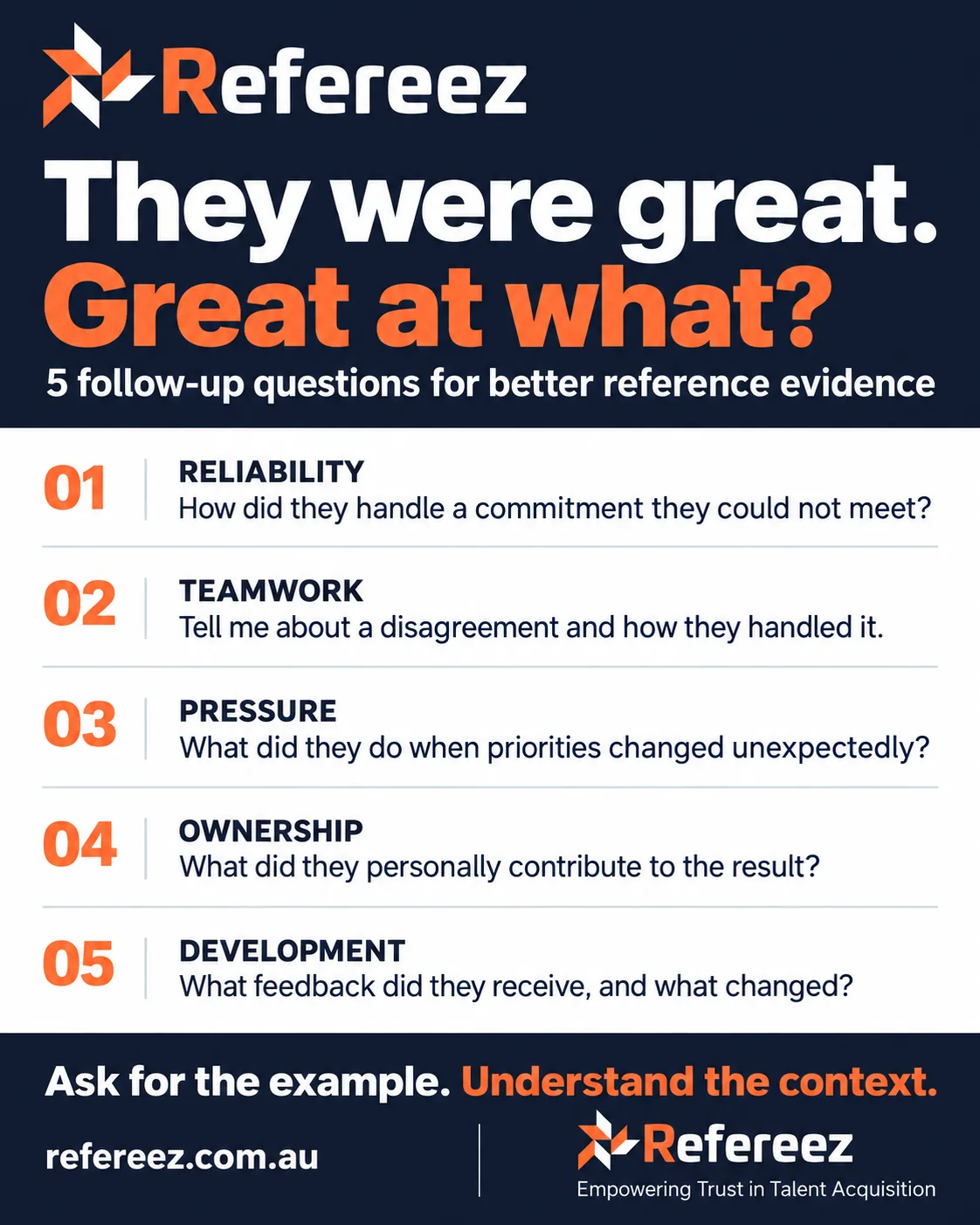
“They were great.”
It is a positive answer. It also leaves plenty to explore.
Great at managing competing priorities? Supporting a new team member? Following through when something became difficult?
The follow-up is where those distinctions become clearer. Here are five practical reference check questions to help Australian recruiters and hiring managers move from a broad impression to a more useful account of work performance.
Start with what the referee actually observed
Before discussing performance, establish how the referee worked with the candidate, over what period and how closely they observed the relevant work. A direct supervisor, project lead and colleague may each offer a different perspective.
Briefly explain the responsibilities of the proposed role. This helps the referee understand which parts of their experience are relevant.
Use a consistent set of core questions for comparable roles, then clarify individual answers where needed. Invite referees to say when they did not observe something or cannot recall an example. A gap in the referee's knowledge should remain a gap in the evidence.
1. Reliability: how did they handle a commitment they could not meet?
“Were they reliable?” can produce a quick answer. Exploring a specific commitment helps you understand what reliability looked like in practice.
First establish whether the referee recalls a relevant situation. If so, ask:
“How did they handle a commitment they could not meet?”
Explore when the candidate recognised the problem, who they informed and what happened next. Consider the workload, resources and circumstances alongside the response.
For example, an early conversation about a deadline at risk may reveal useful planning and communication. A missed deadline alone tells you much less about those behaviours.
A useful follow-up is: “What did they do to help the team manage the impact?”
2. Teamwork: tell me about a disagreement and how they handled it
Teamwork becomes easier to understand when the referee describes an interaction they observed.
“Tell me about a disagreement and how they handled it.”
Ask about the issue, the candidate's contribution to the discussion and how the people involved moved forward. Keep the focus on workplace behaviour relevant to the role.
Consider whether the candidate listened, explained their reasoning and worked towards a practical resolution. A disagreement may also reflect someone constructively raising a concern.
If the referee cannot recall a disagreement, ask for an example of the candidate working with someone whose priorities differed from their own. Record the limits of what the referee can describe.
3. Pressure: what did they do when priorities changed unexpectedly?
“Good under pressure” can describe very different working environments. The detail helps a hiring manager judge how relevant the experience is.
“What did they do when priorities changed unexpectedly?”
Ask what changed, which responsibilities the candidate held and how they responded. Explore communication, prioritisation and when they sought support.
In a project environment, this might involve a revised delivery deadline. In a recruitment team, it could involve an urgent change to an agreed start date. These are illustrative situations to guide the conversation.
The useful information is the candidate's response within that context. Working longer hours, by itself, provides limited insight into the quality of their judgement or decisions.
4. Ownership: what did they personally contribute to the result?
A strong team outcome can reflect several people's work. Clarifying the individual's role gives the hiring team a more accurate picture of their contribution.
“What did they personally contribute to the result?”
Ask which decisions, tasks or improvements the candidate owned. Explore the support they received and the parts delivered by others.
Follow with: “How did you observe that contribution?”
This creates space to distinguish firsthand observations from information the referee heard elsewhere. Record that distinction, especially where an example will influence the hiring discussion.
5. Development: what feedback did they receive, and what changed?
A reference can also help a manager prepare to support a new employee.
“What feedback did they receive, and what changed?”
Ask for a work-related example: the feedback, the candidate's response and any change the referee observed over time.
Someone who needed clearer priorities early in a role may later have worked independently. The sequence matters. Recording only the initial development point would lose that context.
A useful final question is: “What should their next manager understand to help them settle in and perform well?”
Treat the answer as one informed perspective to consider alongside the candidate's own account and the requirements of the new role.
A simple way to capture the answer
For each relevant example, record four things:
| Element | What to capture |
|---|---|
| Context | The situation, responsibilities and working conditions. |
| Action | What the candidate personally did. |
| Outcome | What happened, including anything still uncertain. |
| Observation | How the referee knows and what they directly observed. |
Keep the referee's account separate from the hiring team's interpretation. Where a material point remains unclear, record the question that needs resolving and who will follow it up.
Avoid treating a short answer, a delayed response or an inability to recall an example as a performance finding in itself.
Choosing digital questions or a phone conversation
These prompts can work in a structured digital questionnaire or a phone conversation. Digital questions give referees a clear framework and space to respond. A focused conversation can help clarify ambiguity or explore the context behind an answer.
Choose the follow-up according to what the hiring team still needs to understand. The method supports the assessment; the hiring team remains responsible for weighing the information alongside other evidence.
Refereez offers structured digital checks, recruiter-led phone references and professional reporting for Australian hiring teams. A workflow discussion can help identify where your process needs more consistent questions or additional human follow-up.
Want to make your reference information more useful? Explore Refereez and book a demo. Bring an example of the questions your team currently uses and the information your hiring managers need.